

We tend to see political history as punctuated by notable presidential elections, such as Ronald Reagan’s victory in 1980 or Barack Obama’s 28 years later. Midterm elections often represent backlash after those presidential triumphs, taking the shine off the new president, often switching control of Congress, and slowing the administration’s ambitions and momentum. Despite these second-year rebukes, these presidents have often won reelection, although Trump in 2020 and Jimmy Carter in 1980s were notable exceptions.
This year appears likely to bring a similar swing, in what political scientists sometimes call a “thermostatic” reaction to the previous election (as when a thermostat switches on and off to adjust between too hot and too cold). In this case, it will also be a specific response to the ideological excesses, broken promises, and epic corruption of the Trump administration.
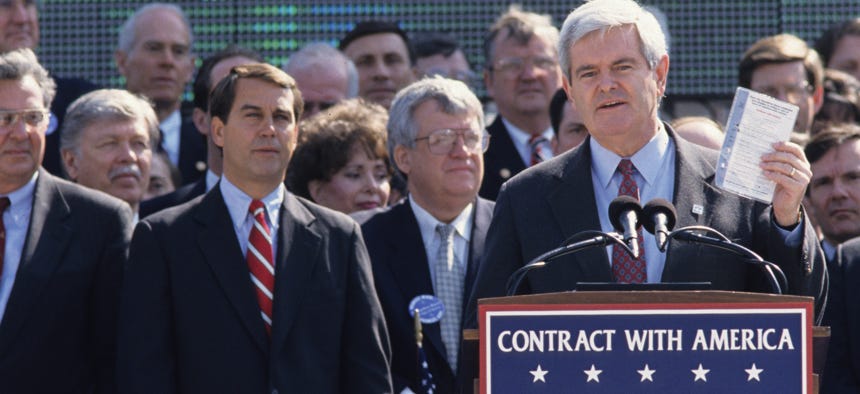
Some midterm backlashes are not much more than that— thermostatic swings in the numbers and majorities in Congress, after which the administration settles back to a compromised middle period. But other midterm elections have an impact that goes well beyond the electoral numbers, and consequences that last longer than a two-term presidency. A “blue” or “red” “wave” is usually measured by the number of seats flipped and the winning party’s new margin in each House of Congress. But there have been midterms that had consequences beyond the numbers. In the 1994 midterm, for example, voters not only repudiated Bill Clinton’s modest tax increases and clumsy attempt at health reform, the election also broke a four-decade run of Democratic control of the House that had been baked into assumptions about how Washington worked. And it brought to power Newt Gingrich and an arrogant, ugly, gleefully dishonest mode of Republican politics that has deepened over 30 years. Although Gingrich’s hubris caught up with him just a few years later, Republicans held onto the House for the next 12 years, and 24 of the last 30.
A comparable counterreaction to Obama, in 2010, probably mattered even more. . Aside from recapturing the House just four years after Democrats won it back, the GOP achieved “trifectas” — full control of the state legislature and governor’s office — in 23 states, at just the right time to control redistricting after the 2010 census. They were able to lock in not only future gains in the House, but also use gerrymandering to perpetuate control of state legislatures for the next 16 years. As a result, even when states like North Carolina, Pennsylvania and Wisconsin have elected Democratic governors, those governors ability to achieve change have been sharply constrained.
Not only did the recent practice of aggressive partisan gerrymandering, even mid-decade or weeks before an election, have its roots in that moment, a new mode of politician emerged, the Tea Party and later the Freedom Caucus Republican: even more willing than the Gingrich crowd to engage in vicious political language, with a strong view of politics as a conflict of “makers and takers,” uninterested in finding shared ground on immigration, social policy, or other issues where their predecessors had been more cautious. Although they were more similar in style than substance, the Tea Party reactionaries walked so Trump could run.
One source of Republican and conservative resilience over the last few decades is simply that they gained more durable power from their midterm wins than Democrats took from theirs.
You’ll notice that I’ve cited two notable backlash elections won by Republicans. A theory I’m testing here is that one source of Republican and conservative resilience over the last few decades is simply that they gained more durable power from their midterm wins than Democrats took from their own successes. In the last 50 years, Democrats have had big midterms in 1982 (amid the Reagan recession), 2006, and 2018, gaining between 26 and 41 House seats in each. Not only were those smaller numbers than the 54 and 63 seats Republicans gained in 1994 and 2010, these were fairly standard elections in which the numbers and majorities changed, but not much else.1 For the most part, Democrats regained swing districts with more ideologically moderate candidates, or continued a pattern of gains in traditionally Republican districts in the Northeast, in affluent suburbs, and in diversifying areas such as in California.
Many of the House members elected in those Democratic cycles were predictably more ideologically “moderate” than their colleagues, and thus also more cautious, and later they were often unreliable allies to the Democratic presidents elected in 2008 and 2020. Again, this is a theory and deserves a more careful quantitative analysis, but my hypothesis is that midterm gains in 2006 and 2018 mostly pulled the Democratic caucus to the right, while Republicans’ big midterm wins also bolstered the right wing of their caucus, shifting the whole system rightward. Republican midterms changed their party and the scope of political possibility in ways that Democratic backlash wins did not.
A Democratic Midterm that Really Mattered
You might have noticed that I limited my analysis above to “the last 50 years.” If we open the aperture by just two more years, we could include the 1974 election, which would have been the second midterm of the Nixon presidency, if Nixon had not already resigned and turned the White House over to Gerald Ford. Democrats gained 48 House seats that year, and five in the Senate, more than in any midterm since. But more notably, the Class of ‘74, sometimes known as the Watergate Babies, brought an attitude and energy that was a noticeable break from the establishment Democrats of that time.
Above all, it was a generational shift, as the first Boomers reached adulthood, shaped by the experience of opposition to the Vietnam War, wider access to higher education (including law school), and in reaction to the corruption of the Nixon administration. Some younger members had already emerged in 1972, such as Colorado representative Patricia Schroeder and New York’s Elizabeth Holtzman, both of whom broke through in primaries, in Holtzman’s case defeating the liberal, but far-too-old chairman of the House Judiciary Committee. Another member of the 1972 group was Joe Biden, also not quite a Boomer but still not old enough to serve in the Senate on the day he was elected.
The 1974 class included figures such as California’s Henry Waxman, one of the most productive legislators in modern history and a master of investigations, and Gary Hart, who had been George McGovern’s campaign manager in 1972 and later an ill-fated, underappreciated presidential candidate himself. Bill Clinton first ran for office in 1974, unsuccessfully, and Al Gore’s political career began two years later. The 1970s Democrats overthrew several octogenarian committee chairs, took reform and transparency seriously, embraced the consumer and environmental movements, and understood that developing expertise on a complex issue could be a source of political power on its own. And in part because quite a few of them had defeated older incumbents who had lost touch with their constituents, they were determined not to repeat those mistakes, building robust constituent services operations and filling their time at home with town hall meetings and other ways to remain accessible, including to hostile constituents. That level of personal engagement enabled many to hold their seats for decades even as their districts moved to the right.
By the 1990s, when I worked in the Senate, Democratic politicians first elected in the 1970s were at the peak of their formal power. Many, such as Clinton, had begun to seem compromised, especially in confronting the economic inequalities and neoliberal consensus that emerged in the 1980s. They showed little appreciation for the traditional New Deal vision represented by some of the old chairmen they ousted. Hart’s comment, “We’re not a bunch of little Hubert Humphreys,” is often quoted as evidence of their rejection of progressive politics, and its true that they had lost the deep connection to New Deal liberalism that, thankfully, animates many progressives today. In part that’s because Humphrey, who as vice president had been constrained from speaking out about Vietnam in roughly the same way Kamala Harris was about Gaza, really did represent the ways in which the older Cold War liberal tradition had gone off the tracks.
But my point is not so much about the ideological commitments of the 1970s politicians, which varied widely, but their approach to politics, which was inclusive, aspirational, energetic, reformist and at best, daring. Similarly, for all the attention to the ideological positioning of the 2026 candidates, it’s their approach to politics—their tone and energy—that is most distinctive. Obviously, they too are young at a moment when the political establishment is mired in gerontocracy, but they also seem willing to engage with people of various kinds and in a way that politicians of the last two decades, constrained by cautious demographic micro-targeting of voters and media, have not been. They are able to be themselves, to share aspects of their lives that older politicians would never consider, with Alexandria Ocasio-Cortez’s charming and informative videos about her decision to freeze her eggs as the ultimate expression of that openness.
There are sometimes uncanny parallels: Just as Patricia Schroeder was a 32-year-old lawyer who challenged an establishment Democrat on an anti-war platform and defeated a Republican incumbent in 1972 to win the Denver congressional seat, Melat Kiros is a a 29-year-old lawyer who defeated Schroeder’s successor, Diana DeGette, for the same seat.2
Even when their ideological positions might seem out of step, or perhaps just ahead of public opinion as measured by polls, these candidates have the tangible advantage that they are saying what they actually believe. That has an appeal of its own. For example, I’m not an enthusiastic advocate for single-payer health care or Medicare for All. (I appreciate it as an ideal, but worry about the transition and the potential for backlash, just because health care change makes people particularly anxious.) But it doesn’t make me like Michigan Senate candidate Abdul El-Sayed any less to hear him make a passionate, knowledgeable case for M4A, rooted in his own experience and expertise. That kind of commitment can connect to voters in a way that poll-tested, compromised positions rarely will.
These Democratic candidates also share a commitment to structural reforms and accountability for corruption, much like the ‘70s cohort who essentially constructed the mechanisms of accountability and limits on power that held for half a century. Where establishment Democrats shift every conversation to “affordability” and the poll-tested messages, newer Dems connect those concerns to Trumpian corruption and abuse of power, including the political influence of billionaires.
Perhaps some or many of these younger Democrats will lose, whether because of their positions or their lack of political experience, name recognition or (least likely) money. Even in big midterm sweeps, such as 2010, some challengers don’t make it. But if candidates like el-Sayed, Florida nominee Angie Nixon, or various younger insurgent House candidates do succeed, 2026 will be the kind of midterm election that Democrats have not seen in many decades, one that transforms the basic rules of politics, for a decade or more to come.
Senate gains often follow a different pattern, because so much depends on which third of the Senate is up for reelection in a given cycle. So, for example, Democrats didn’t gain any Senate seats in their 1982 midterm win, but in 1986, when the Republican senators who swept in with Reagan in 1980 were on the ballot again, Democrats gained eight seats and control of the chamber.
This is already the House seat held by a woman for the longest continuous period, 56 years if Kiros wins and completes a term.
An election becomes historical when it changes the machinery governing the next one.
The 1974 class built oversight capacity. The 1994 class rewrote congressional behavior. The 2010 class captured maps and institutions.
The measure of 2026 is what remains after the wave recedes.